


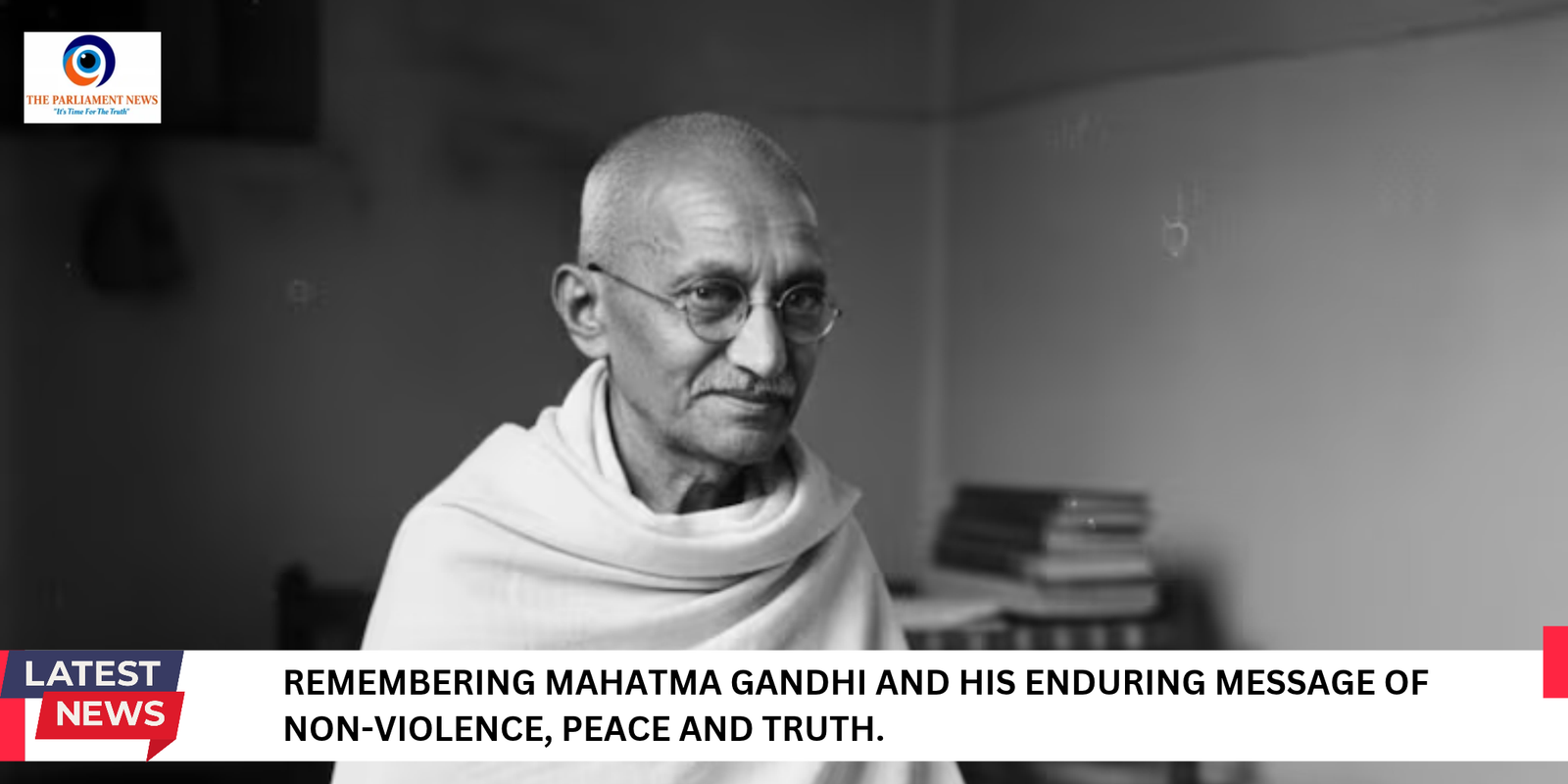
New Delhi, October 2, 2026: India is observing Gandhi Jayanti today, marking the 157th birth anniversary of Mahatma Gandhi. Across the country, the day is being observed through commemorative programmes and tributes, while a national Sarva-Dharma Prarthana is scheduled in New Delhi.
But October 2 carries significance beyond Gandhi’s birth anniversary. The United Nations also observes the date as the International Day of Non-Violence, giving the day a place on both India’s national calendar and the international calendar. The UN established the observance in 2007 to promote awareness of non-violence and a culture of peace, tolerance and understanding.
Gandhi was born on October 2, 1869, in Porbandar, Gujarat. He later became one of the central figures of India’s freedom movement, using non-violent resistance and civil disobedience as important methods of political mobilisation.
His approach was different from a conventional armed struggle. Campaigns associated with Gandhi sought to bring large numbers of ordinary people into the independence movement through methods including non-cooperation, peaceful protest and civil disobedience.
The Non-Cooperation Movement, the Salt March of 1930 and the Quit India Movement of 1942 became important chapters in the broader struggle against British rule. The Salt March, in particular, turned opposition to the British salt laws into a mass movement and became one of the most recognised episodes of the independence struggle.
The historical record of Gandhi and the freedom movement is extensive and has also been subject to different interpretations and debates. However, non-violence remained a defining element of Gandhi’s political method and public philosophy.
The international significance of October 2 developed decades after Gandhi’s death.
In June 2007, the UN General Assembly adopted a resolution establishing October 2 as the International Day of Non-Violence. The resolution called for the message of non-violence to be spread through education and public awareness and reaffirmed the universal relevance of the principle.
The UN describes Gandhi as a pioneer of the philosophy and strategy of non-violence and notes that his approach has influenced movements for civil rights and social change around the world.
That gives October 2 a significance beyond the Indian independence story. The date is now used internationally to discuss peaceful methods of addressing social and political conflicts.
Non-violence, as used in Gandhi’s political campaigns, did not simply mean remaining passive in the face of injustice.
The UN’s explanation of non-violent action includes methods such as protest and persuasion, non-cooperation and non-violent intervention. Such methods seek political or social change without the use of physical violence.
Gandhi used these principles to encourage participation in India’s freedom movement. His campaigns demonstrated how boycotts, marches, civil disobedience and withdrawal of cooperation could become instruments of mass political action.
This distinction is important because Gandhi’s legacy is often reduced to a single word non-violence while his political strategy involved organised participation, resistance and public mobilisation.
In India, Gandhi Jayanti is marked through official ceremonies, prayer meetings and programmes in schools, institutions and communities. Raj Ghat in New Delhi, where Gandhi’s memorial is located, remains a major site for national tributes.
The 2026 observance also includes a Sarva-Dharma Prarthana in New Delhi, according to the Press Information Bureau.
At the international level, the United Nations continues to mark October 2 as the International Day of Non-Violence. In its 2026 message, UN Secretary-General António Guterres highlighted Gandhi’s example of pursuing change through peace and dialogue and linked the observance to the need to address division, conflict and human suffering through non-violent means.
For India, Gandhi Jayanti is closely connected to the country’s history of independence. For the wider international community, the date has become associated with the broader principle of non-violence.
The two observances overlap but are not identical. One remembers a major figure in India’s freedom struggle; the other uses his birth anniversary to promote a principle that the United Nations describes as having universal relevance.
That dual identity makes October 2 different from an ordinary commemorative date. It connects a specific chapter of Indian history with an international discussion about how societies respond to conflict, disagreement and injustice.
As India marks Gandhi Jayanti in 2026, the occasion therefore looks in two directions at once back at the freedom movement that shaped modern India and outward at the continuing global discussion around peace, dialogue and non-violent action.
