


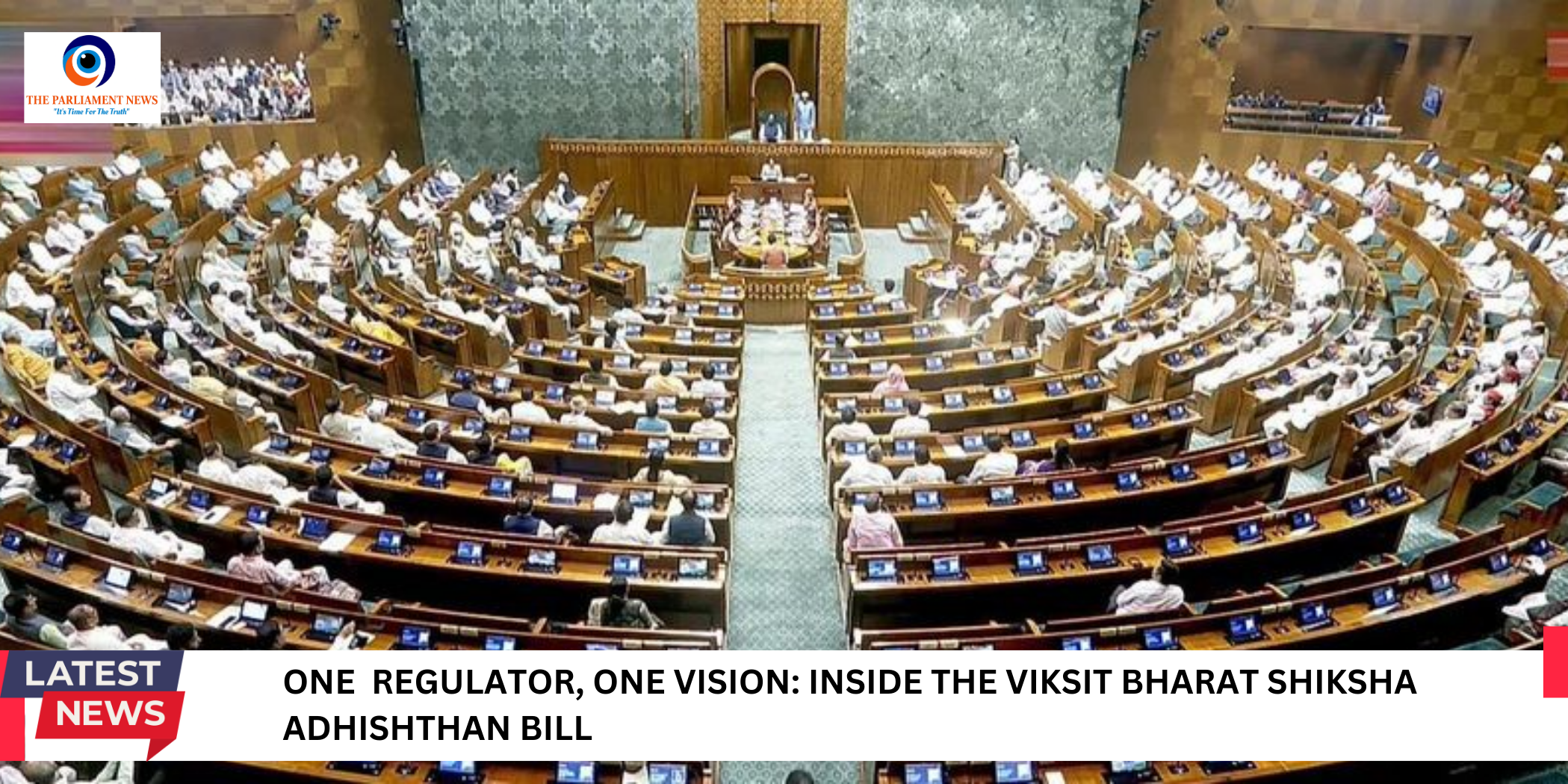
On December 15, 2025, the Winter Session of Parliament marked a significant milestone for India’s education landscape. Union Minister for Education Dharmendra Pradhan introduced the Viksit Bharat Shiksha Adhishthan Bill, 2025 in the Lok Sabha, signalling the government’s intent to fundamentally reshape how higher education is governed and regulated in the country.
The Bill’s introduction stood out amid a session dominated by political sparring, positioning education reform as a central pillar of India’s long-term development agenda.
Moving Away From a Fragmented System
For decades, India’s higher education sector has operated under multiple regulatory bodies, often leading to overlapping mandates, slow approvals, and policy inconsistency. The proposed legislation seeks to end this fragmentation by establishing a single apex authority called the Viksit Bharat Shiksha Adhishthan.
If enacted, the new body will absorb the roles of existing regulators such as the University Grants Commission, the All India Council for Technical Education, and the National Council for Teacher Education. The objective is clear: streamline governance, cut red tape, and ensure that institutions deal with one coherent regulatory system instead of many.
Three Councils, One Unified Vision
Rather than concentrating power in a single vertical, the proposed framework introduces a structured approach through three independent councils. Each council will focus on a distinct area—academic standards, regulation, and accreditation.
This separation is intended to strengthen transparency and accountability, ensuring that quality assurance, compliance, and benchmarking are handled with clarity and independence. Supporters of the Bill argue that such a structure could reduce arbitrary decision-making while raising institutional trust in the regulatory process.
Technology at the Core of Reform
One of the most notable features of the Bill is its emphasis on a technology-driven, faceless approval system. The proposed single-window digital mechanism aims to simplify permissions, reduce delays, and limit human discretion in decision-making.
By relying on transparent digital processes, the government hopes to make compliance easier for institutions, encourage faster approvals, and create a more predictable regulatory environment. This shift is also seen as a move toward aligning Indian higher education governance with global best practices.
Autonomy, Innovation, and Global Aspirations
The Bill places strong emphasis on granting greater autonomy to high-performing institutions. By reducing excessive regulatory controls, it seeks to encourage innovation, interdisciplinary learning, and research excellence.
At the same time, the framework aims to ensure that autonomy does not come at the cost of equity. The legislation underscores the importance of expanding access to quality education, particularly as India works to position itself as a global education hub.
In Step With NEP 2020
The proposed law closely aligns with the National Education Policy 2020, which called for systemic reforms, institutional autonomy, and a simplified regulatory architecture. In that sense, the Viksit Bharat Shiksha Adhishthan Bill can be seen as a legislative bridge between policy vision and on-ground implementation.
By embedding NEP principles into law, the government is signalling its intent to move from reform rhetoric to structural change.
Why This Bill Matters
The introduction of the Bill represents more than administrative restructuring. It reflects a broader vision of preparing India’s higher education system for the demands of a rapidly changing global economy—one that values flexibility, innovation, and international competitiveness.
As parliamentary scrutiny and debate unfold in the coming weeks, the Bill is expected to draw wide attention from universities, educators, and students alike.
