


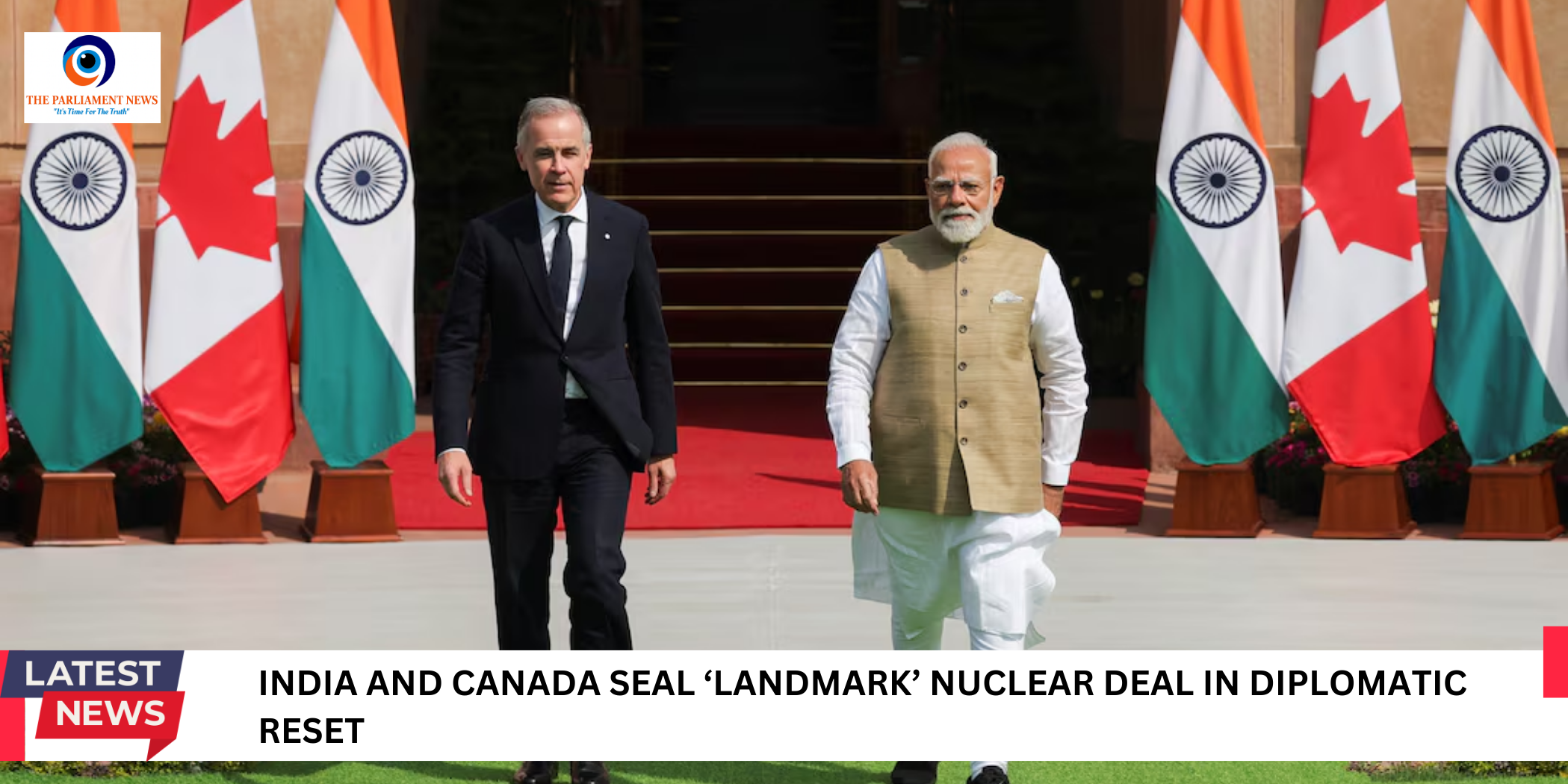
Narendra Modi and Mark Carney have announced a series of agreements including a 10-year nuclear energy deal following talks in New Delhi aimed at restoring relations after a period of sharp diplomatic tensions.
The two leaders also advanced cooperation in technology, critical minerals, space, defence, education and trade, signalling a broader reset in bilateral ties.
Nuclear Energy Partnership
Speaking after their meeting at Hyderabad House in Delhi, Modi described the civil nuclear agreement as a “landmark deal” that will ensure long-term uranium supply from Canada to India.
“In civil nuclear energy, we have reached a landmark deal for long-term uranium supply. We will also work together on small modular reactors and advanced reactors,” Modi said.
Carney said Canada is well positioned to help meet India’s growing energy demands and confirmed the launch of a new strategic energy partnership between the two countries.
Trade Deal Targeted by 2026
Both sides committed to finalising a long-pending comprehensive economic partnership agreement (CEPA).
Carney said they aim to conclude the deal by the end of 2026, while Modi set a bilateral trade target of $50bn.
The agreement has been discussed intermittently for nearly 15 years. Its conclusion would mark a major breakthrough as both nations seek to reduce exposure to US trade tariffs and diversify economic partnerships.
Rebuilding After Diplomatic Crisis
Relations between the two countries deteriorated in 2023 after then–Canadian Prime Minister Justin Trudeau accused India of potential involvement in the killing of Hardeep Singh Nijjar on Canadian soil.
India strongly denied the allegations. Diplomatic relations nearly froze as both countries expelled diplomats and suspended visa services.
Canada’s spy agency later listed India among countries allegedly involved in foreign interference, alongside Russia, China and Iran. However, under Carney’s leadership, Ottawa has said it believes India is not currently linked to violent crimes or threats on Canadian territory.
Despite this, some Canadian lawmakers and members of the Sikh diaspora continue to raise concerns about interference.
Canadian Foreign Minister Anita Anand defended the government’s decision to re-engage with India, saying diplomatic dialogue was essential for progress, though she distanced herself from remarks by a senior official suggesting India had ceased all foreign interference activities.
The legal case against four men charged in Nijjar’s killing remains before Canadian courts.
Expanding Strategic Cooperation
During the Delhi talks, both leaders emphasised shared democratic values and strong people-to-people ties, noting Canada’s large Indian diaspora.
Modi described the two countries as “natural partners in technology and innovation”, announcing enhanced cooperation in:
- Artificial intelligence
- Supercomputing
- Semiconductors
- Renewable energy (including a jointly hosted summit)
- Space and defence collaboration
Earlier in the trip, Carney met India’s External Affairs Minister S. Jaishankar to discuss a “forward-looking partnership”.
Geopolitical Context
Analysts say the reset reflects shifting global dynamics. Canada is seeking to diversify trade and reduce vulnerability to US tariffs, while India aims to broaden its energy partnerships and decrease reliance on Russian imports.
Public opinion in Canada appears supportive of renewed engagement. A recent Angus Reid poll found that half of Canadians believe it is the right time to restore ties, with more respondents expressing favourable views of India than of the United States.
Carney’s four-day visit began in Mumbai, where he met business leaders to promote investment. After India, he is scheduled to travel to Australia and Japan as part of Canada’s broader Indo-Pacific diversification strategy.
