

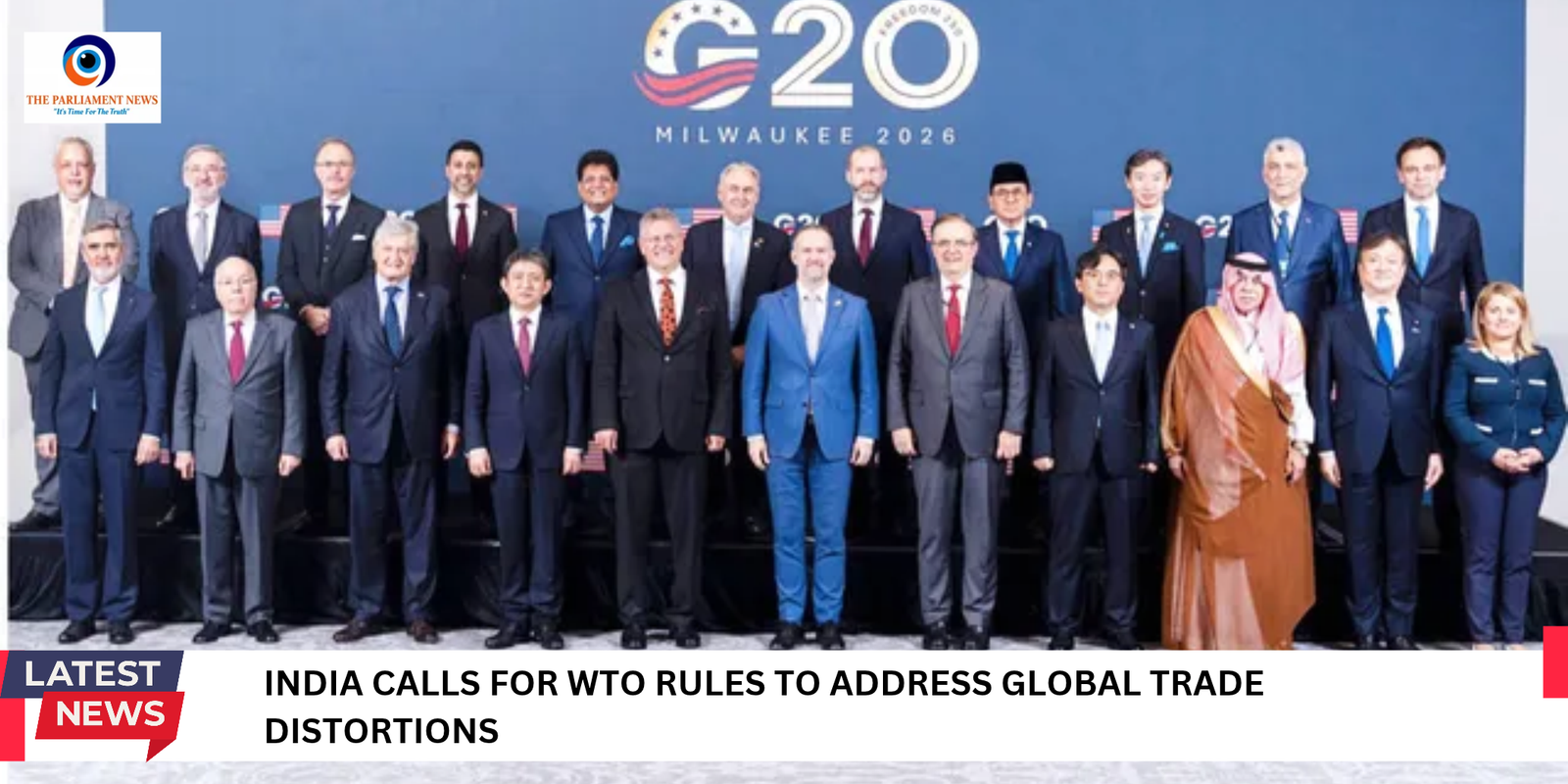
India has called for global trade concerns, including production imbalances and possible market distortions, to be addressed within World Trade Organization (WTO) rules, with Commerce and Industry Minister Piyush Goyal stressing the need for evidence-based measures at the G20 Trade Ministers’ Meeting in Milwaukee, United States.
Addressing the concluding day of the meeting, Goyal said India recognised concerns among several countries over the impact of trade-distorting support on global markets. He said issues such as dumping and predatory pricing should be dealt with through established WTO mechanisms, including anti-dumping and countervailing duties, where supported by evidence and subject to judicial review.
Goyal distinguished between industrial capacity and trade distortion, saying that production capacity by itself should not be treated as a problem. According to him, distortions may emerge when production becomes concentrated in particular locations because of hidden subsidies or other forms of support.
He said efforts to diversify global production and supply chains could be legitimate, but such objectives should not be used to introduce measures outside WTO rules. He also stressed that developing countries should not be required to bear a disproportionate share of the adjustment and should retain sufficient policy space to build their industrial capacity.
The minister said India’s manufacturing base caters to both domestic and international demand. He described the country as a large domestic-demand-driven economy and said India was developing manufacturing value chains covering activities from design to finished products.
Goyal also rejected the characterisation of India as having structural excess capacity in the sectors identified by the G20 Presidency. He said India’s manufacturing expansion is linked to domestic requirements as well as its participation in international supply chains.
Another focus of Goyal’s intervention was the future of the multilateral trading system. He said India’s trade with G20 economies depends on a transparent, non-discriminatory and rules-based framework.
He highlighted the Most-Favoured-Nation principle as an important element of the WTO system, under which members generally extend the same trading terms to other WTO members. Goyal also stressed the importance of consensus-based decision-making and called for maintaining special and differential treatment for developing countries.
He further called for the restoration of the WTO’s two-tier dispute settlement system, which India has previously identified as important for the effective enforcement of multilateral trade rules.
Forced labour in global supply chains was another issue discussed during the meeting. Goyal said India’s commitment to eliminating forced labour was “absolute and unconditional”, while emphasising that trade-related action should be based on specific and verifiable evidence.
He said border measures should not be based on assumptions about entire countries, regions or sectors and should follow due process and WTO rules. India also supports voluntary cooperation among G20 members on eliminating forced labour, provided such cooperation does not create new obligations or become a basis for unilateral trade action.
Goyal pointed to India’s existing legal and policy framework on the issue, including its ratification of International Labour Organization Conventions 29 and 105. He also noted that India amended its Foreign Trade Policy in July 2026 to prohibit imports of goods produced using forced labour.
The Milwaukee meeting also provided an opportunity for India to engage bilaterally with other G20 members. Goyal held meetings with trade counterparts from Australia, Saudi Arabia, France, South Korea and Canada.
The minister reaffirmed India’s support for a fair, transparent, open, inclusive and non-discriminatory multilateral trading system with the WTO at its core. He also emphasised the importance of allowing developing economies sufficient policy space to pursue industrialisation, economic growth and food security.
The G20 Trade Ministers’ Meeting was held under the United States’ G20 Presidency. India’s participation focused on trade rules, production capacity, supply-chain issues, labour standards and the broader functioning of the multilateral trading system.
