


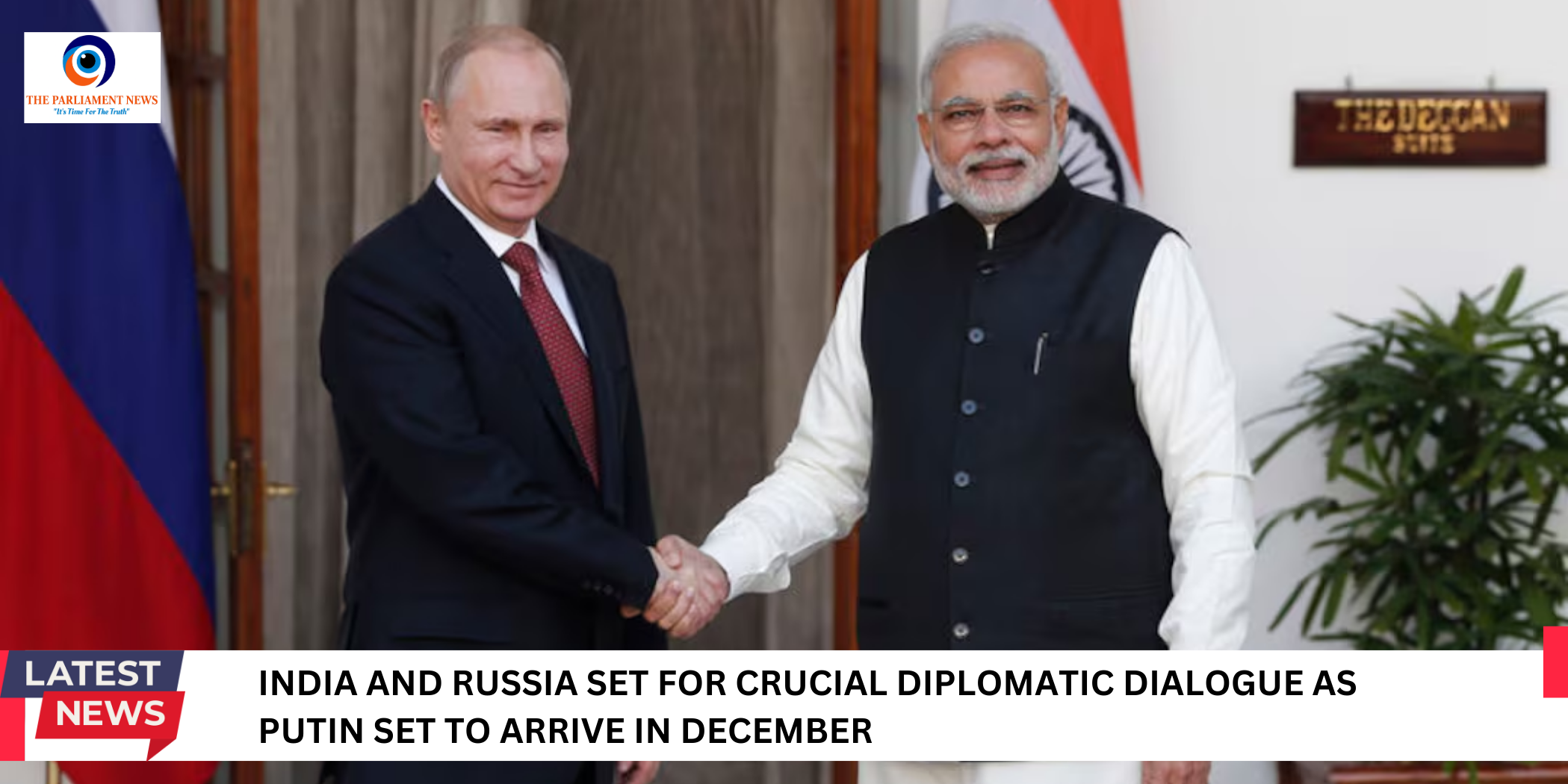
Russian President Vladimir Putin is set to visit India on December 4 and 5 for the 23rd India-Russia Annual Summit, marking an important diplomatic moment in the midst of a turbulent global environment. His arrival comes at a time when the Russia-Ukraine war continues without pause and when shifting geopolitical alliances are reshaping global power equations.
For India, this visit provides a moment to reassess and reaffirm one of its longest-standing relationships. For Russia, it signals continuity, partnership, and an opportunity to engage a trusted ally in a rapidly evolving world.
A High-Level Diplomatic Engagement
The Ministry of External Affairs confirmed that President Putin will lead the Russian delegation for the upcoming summit, an event that has traditionally served as the cornerstone of bilateral engagement. The Indian leadership, led by Prime Minister Narendra Modi, is expected to hold wide-ranging discussions covering defence cooperation, energy trade, regional security, and large-scale economic projects.
President Droupadi Murmu will host a state banquet in honour of the Russian leader, further underscoring the ceremonial and diplomatic importance attached to the visit. This marks President Putin’s first trip to India since December 2021, making it a long-awaited engagement between the two sides.
A Strategic Partnership Under Global Pressure
India and Russia have maintained what both nations describe as a “Special and Privileged Strategic Partnership,” built over decades of defence collaboration, space cooperation, energy initiatives, and multilateral coordination. However, the global landscape surrounding this partnership has dramatically changed since Russia launched what it calls a “Special Military Operation” in Ukraine in February 2022.
Western sanctions against Moscow forced Russia to reconfigure several of its commercial channels, which unexpectedly led to a sharp rise in India-Russia energy cooperation. Today, Russian oil is a significant part of India’s import basket, reshaping trade dynamics between the two countries.
But this energy engagement has also caused friction with Washington. India faced punitive U.S. sanctions earlier this year, prompting renewed debate over how India balances ties between major global powers. Despite external pressure, India’s position has remained consistent: a call for diplomacy, de-escalation, and dialogue. Prime Minister Modi’s remark that “this is not the time for war” continues to reflect India’s broader foreign policy stance.
A Visit Framed by a New Peace Proposal
The timing of Putin’s trip is equally important. It comes only days after U.S. President Donald Trump announced a 28-point peace plan aimed at ending the Ukraine-Russia conflict. The proposed framework suggests significant concessions from Ukraine, including territorial compromises and restrictions on its military capability. Although controversial, the proposal sets the stage for renewed debate on how and when the conflict may eventually be resolved.
Putin’s visit to New Delhi, therefore, is not occurring in isolation. It sits at the intersection of global diplomatic efforts, shifting alliances, and intense strategic calculations.
What the Visit Could Achieve
Beyond symbolic gestures, the summit may serve several critical purposes:
Reaffirming Strategic Trust
India and Russia continue to see each other as reliable partners in defence, space, and nuclear collaboration. A face-to-face dialogue can rebuild momentum after years of global disruption.
Strengthening Energy and Economic Cooperation
Russian hydrocarbons have become central to India’s energy security. Expanding this partnership, while navigating sanctions, will be a key agenda point.
Addressing Regional Security Challenges
From Ukraine to the Indo-Pacific, the leaders will exchange views on major security issues that directly influence both nations’ long-term interests.
Charting the Future of Bilateral Engagement
With India’s rising global stature and Russia’s evolving geopolitical strategy, the summit offers an opportunity to outline a refreshed roadmap for cooperation.
