


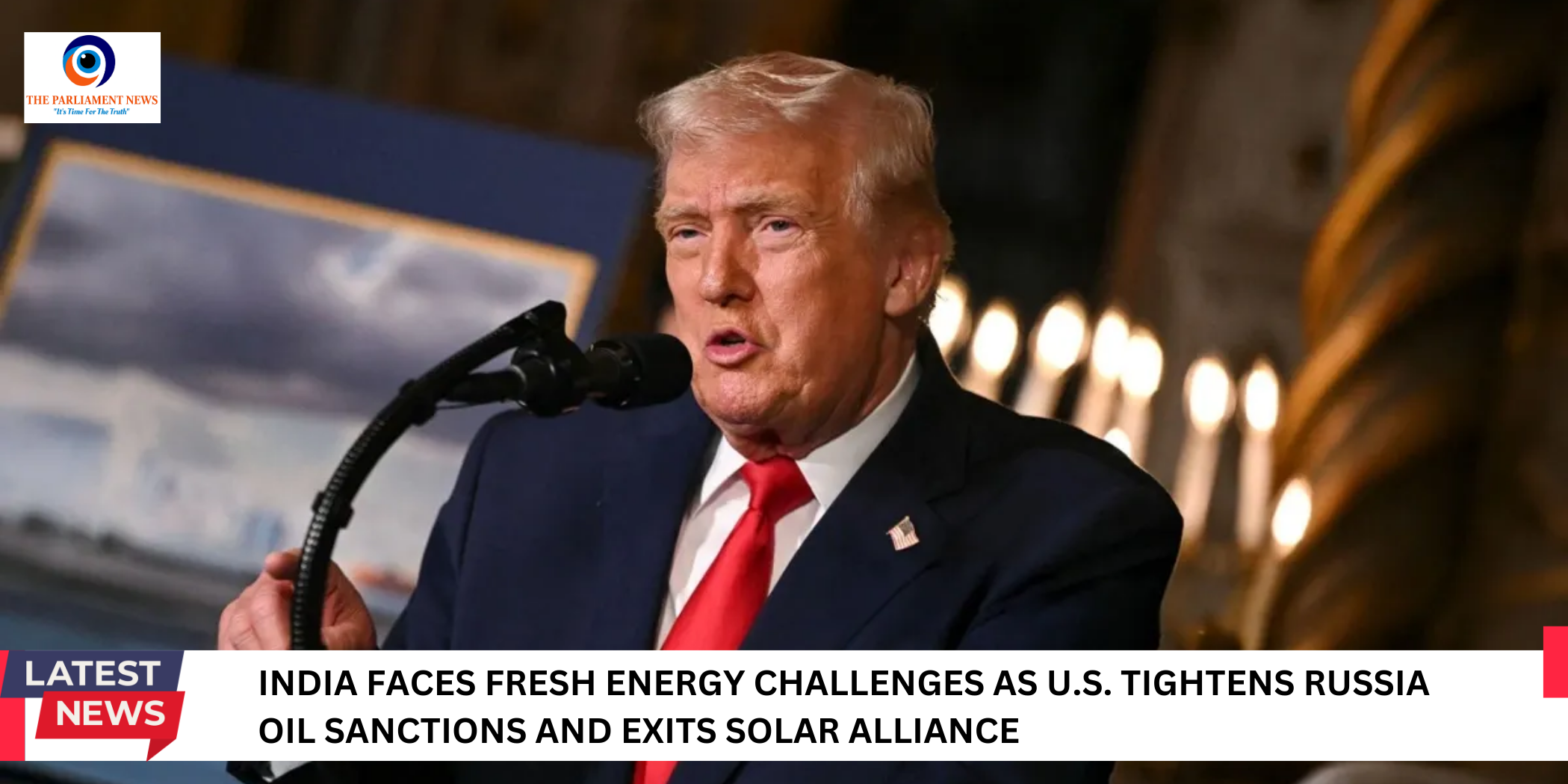
India encountered renewed diplomatic and economic pressure on January 8, 2026, following two major policy decisions announced by US President Donald Trump. The first involves Washington backing a sweeping sanctions Bill that proposes punitive tariffs of up to 500% on countries purchasing Russian oil. The second is the United States’ decision to withdraw from the India-led International Solar Alliance, a move that has wider implications for global climate cooperation.
Together, the announcements have placed India in a difficult position, balancing energy security, strategic autonomy, and its relationship with the United States.
At the heart of the pressure lies the Russia Sanctions Act, a bipartisan Bill with overwhelming support in the US Congress. The legislation empowers the US President to impose severe secondary tariffs on countries that continue to buy or resell Russian oil.
President Trump has publicly endorsed the Bill, describing it as a powerful tool to curb Russia’s war financing. Senior lawmakers backing the proposal have explicitly named India, alongside China and Brazil, as key targets of the sanctions framework.
With the Bill expected to come up for a vote soon, the threat of sharply higher tariffs has become increasingly real.
The timing of the announcements is significant. US Ambassador-designate Sergio Gor is scheduled to arrive in New Delhi on January 12, beginning his tenure as Ambassador and Special Envoy to South and Central Asia.
Mr. Gor has previously stated that ensuring India ends its purchases of Russian oil is among Washington’s top priorities. His arrival is widely seen as the beginning of a renewed diplomatic push to secure a complete halt to Indian imports of Russian crude.
There are indications that India has already begun adjusting its energy sourcing. Reliance Industries recently confirmed that it did not receive Russian oil cargoes at its Jamnagar refinery for much of December and does not expect deliveries in January.
While Indian public sector oil companies briefly increased imports in late 2025, constraints on other major buyers and growing external pressure suggest that Russian oil imports are unlikely to return to earlier levels.
India has faced similar situations before. During earlier US sanctions regimes, New Delhi had entirely phased out oil imports from Iran and Venezuela, demonstrating its ability to recalibrate under sustained pressure.
India’s evolving stance has drawn cautious approval from parts of Europe. During diplomatic engagements in Paris, senior European leaders publicly welcomed the reduction in India’s Russian oil imports, framing it as a step toward limiting Moscow’s war financing.
Notably, these remarks went unchallenged by Indian officials present, suggesting an awareness of the broader geopolitical expectations surrounding energy trade.
Adding to the strain, the United States announced its withdrawal from the International Solar Alliance, an organisation founded by India and France and headquartered in New Delhi. The alliance, with over 90 member countries, was created to accelerate global adoption of solar energy.
When the US joined the alliance in 2021, it was widely seen as a validation of India’s leadership in renewable energy diplomacy. Its exit, along with withdrawal from multiple climate-related international bodies, is now being viewed as a setback for multilateral climate action.
The US decision has sparked concern among climate advocates and policymakers alike. Walking away from global renewable platforms weakens collective efforts to address climate change and undermines confidence in international cooperation.
For India, which has positioned itself as a champion of clean energy and climate partnerships, the move complicates efforts to maintain momentum in global solar initiatives.
India now finds itself at the intersection of competing pressures: safeguarding affordable energy supplies, managing geopolitical alignments, and preserving leadership in renewable energy diplomacy.
How New Delhi responds in the coming weeks particularly during high-level engagements with the new US Ambassador will shape not just its energy policy, but its broader strategic positioning in an increasingly fragmented global order.
