

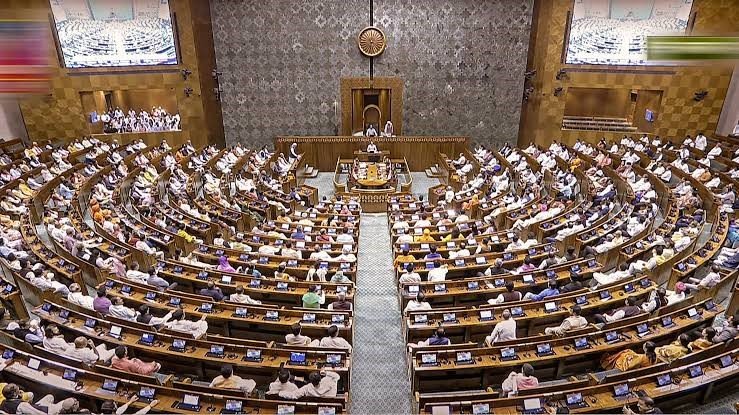
The Union Government is preparing to introduce three major legislative proposals during the special sitting of Parliament beginning November 30, 2026, seeking to expand parliamentary representation, advance 33 per cent reservation for women and revise the delimitation framework. The proposed Constitution (One Hundred and Thirty-Second Amendment) Bill, 2026, the Delimitation (Second) Bill, 2026 and the Union Territories Laws (Amendment) Second Bill, 2026 are expected to form a major part of the Lok Sabha’s legislative agenda. If passed and implemented, the proposals could increase the maximum strength of the Lok Sabha to 850 seats and facilitate women’s reservation ahead of the 2029 general elections.
Three Bills to Be Introduced in Lok Sabha
According to the listed parliamentary business, Law and Justice Minister Arjun Ram Meghwal will introduce the Constitution (One Hundred and Thirty-Second Amendment) Bill, 2026, which seeks to amend the Constitution to facilitate the proposed changes to parliamentary representation and women’s reservation.
Meghwal will also move the Delimitation (Second) Bill, 2026, which aims to establish the framework for readjusting parliamentary and legislative assembly constituencies and implementing reservation for women in the Lok Sabha and state and Union Territory legislatures.
Union Home Minister Amit Shah is scheduled to introduce the Union Territories Laws (Amendment) Second Bill, 2026. The legislation seeks to amend the Government of Union Territories Act, 1963, the Government of National Capital Territory of Delhi Act, 1991, and the Jammu and Kashmir Reorganisation Act, 2019, to align the relevant legal provisions with the proposed changes.
The revised bills replace earlier legislative proposals introduced in April 2026. The earlier delimitation-related constitutional amendment failed to secure the required special majority in the Lok Sabha, leading the government to prepare a revised legislative package.
Lok Sabha Strength Could Increase to 850 Seats
One of the most significant provisions of the proposed framework is a 50 per cent increase in the number of Lok Sabha seats allocated to every state and Union Territory.
India’s current Lok Sabha has 543 elected seats. Under the proposed constitutional framework, its maximum strength would increase to 850, comprising up to 815 representatives from states and 35 from Union Territories.
The proposed increase is also intended to apply to state legislative assemblies, with the maximum permissible strength of state assemblies proposed to rise from 500 to 650 members.
The revised delimitation framework proposes using the 2011 Census figures for redrawing constituency boundaries. At the same time, the existing relative distribution of Lok Sabha seats among states, based on the 1971 Census, would be protected until 2051 under the proposed arrangements.
The changes are intended to expand representation while addressing concerns that states which have successfully controlled population growth could lose their relative parliamentary representation during delimitation.
33% Reservation for Women Ahead of 2029 Elections
Another central objective of the proposed legislation is to facilitate 33 per cent reservation for women in the Lok Sabha and state legislative assemblies ahead of the 2029 general elections.
The Constitution (106th Amendment) Act, 2023, commonly known as the Nari Shakti Vandan Adhiniyam, established the framework for reserving one-third of seats for women. However, its implementation was linked to a future census and subsequent delimitation exercise.
The new legislative proposals seek to modify this arrangement and enable the reservation to take effect following the proposed delimitation exercise.
Under the proposed framework, seats reserved for women would be allocated through rotation, with the Delimitation Commission determining the relevant arrangements. The reservation would also cover women belonging to Scheduled Castes and Scheduled Tribes within the constitutionally prescribed framework.
The government has presented the proposed changes as a way to increase women’s participation in legislative decision-making and expand opportunities for political representation.
Delimitation Framework and Parliamentary Approval
The Delimitation (Second) Bill proposes establishing a Delimitation Commission to undertake constituency readjustment after the legislation comes into force. The Commission would determine constituency boundaries using the latest published Census figures available when the proposed legislation commences.
The proposed framework also includes provisions for increasing the number of parliamentary and assembly seats by 50 per cent and allocating reserved seats for women.
However, the constitutional amendment requires a special majority in both Houses of Parliament. This means it must receive the support of a majority of the total membership of each House, as well as at least two-thirds of members present and voting.
Consequently, the proposals will require substantial parliamentary support before they can become law. Their introduction during the special sitting does not itself guarantee their passage.
Special Sitting of Parliament Begins November 30
The Lok Sabha is scheduled to hold a four-day special sitting from November 30 to December 3, 2026. The Rajya Sabha is scheduled to reconvene separately from December 2 as part of the special parliamentary proceedings.
The legislative agenda includes the introduction of the three revised bills and consideration of the government’s proposed changes to delimitation and women’s reservation.
The President’s recommendation for consideration of the revised Delimitation Bill has also been reported as part of the procedural developments preceding the special sitting.
What the Proposed Changes Could Mean for India
If enacted, the proposals could bring significant changes to India’s parliamentary and electoral structure. An increase in the number of Lok Sabha seats would expand the number of elected representatives, while the proposed women’s reservation would provide a constitutional framework for greater female representation in national and state legislatures.
The proposed delimitation exercise will also have implications for constituency boundaries, parliamentary representation and the distribution of legislative seats across the country.
As Parliament prepares to consider the three bills, their provisions, constitutional requirements and implementation framework will remain important subjects of legislative discussion.
Ultimately, the outcome will depend on whether the proposals secure the necessary parliamentary approval and whether the subsequent delimitation process can be completed in time for the proposed implementation of women’s reservation ahead of the 2029 Lok Sabha elections.
