


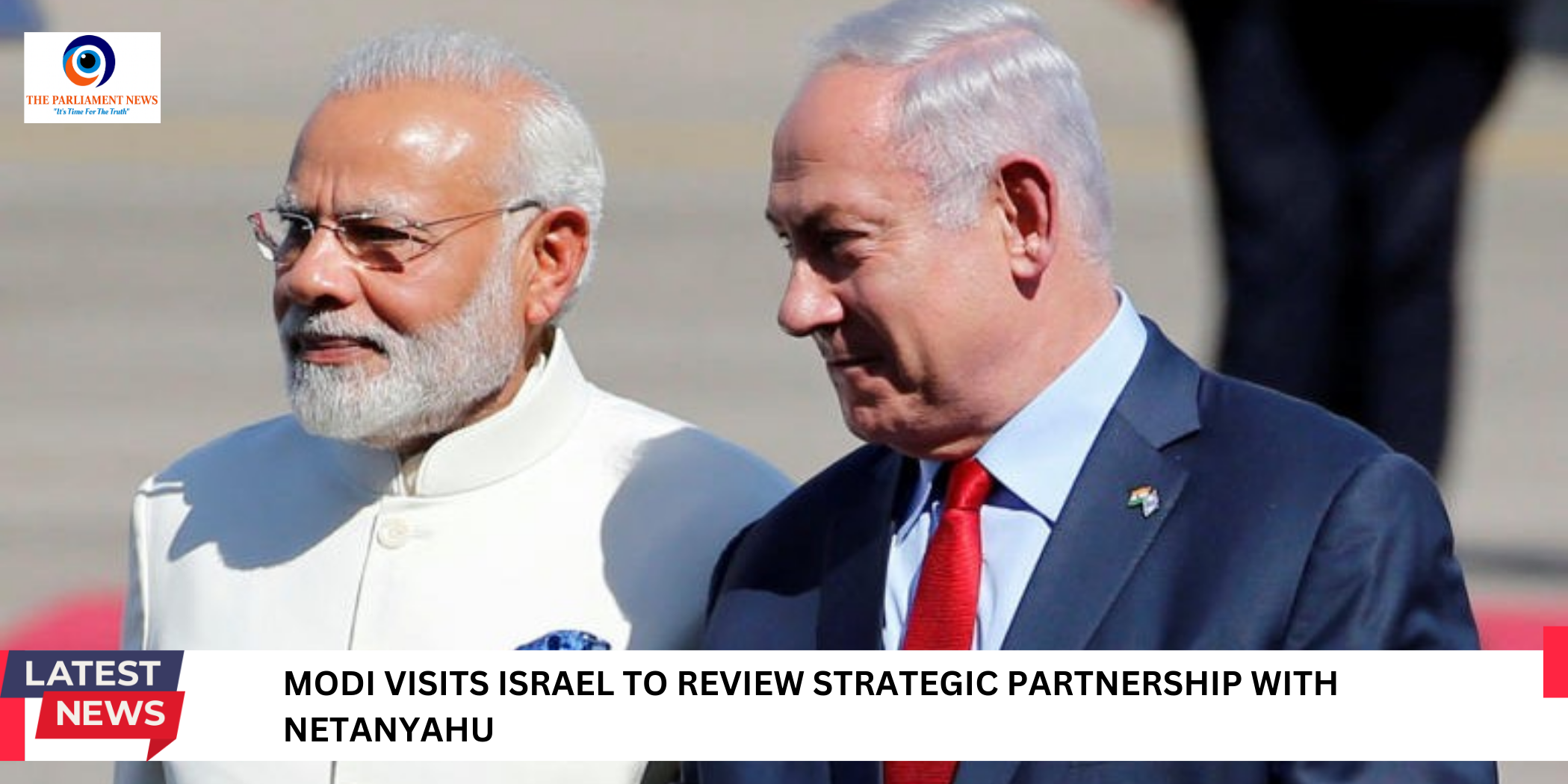
Prime Minister Narendra Modi landed in Israel on Wednesday for talks with his counterpart Benjamin Netanyahu aimed at reviewing the India–Israel Strategic Partnership and identifying new opportunities for cooperation across multiple sectors, including science and technology.
The visit holds diplomatic significance. In 2017, Modi became the first Indian prime minister to visit Israel, marking a visible elevation in bilateral ties. The current visit comes shortly after India joined more than 100 countries at the United Nations in criticising Israel’s actions in the West Bank. New Delhi signed a joint statement after initially refraining from participating in a collective condemnation of settlement expansion.
Diplomatic and Strategic Background
India and Israel established full diplomatic relations in 1992. Since then, ties have expanded steadily, particularly over the past decade, with growing engagement in defence, trade, agriculture, water management, and advanced technologies.
Defence cooperation remains the cornerstone of the strategic partnership. According to data from the Stockholm International Peace Research Institute (SIPRI), India accounted for over 38% of Israel’s arms exports between 2014 and 2024, making it one of Israel’s largest defence customers. Military hardware, surveillance systems, radar technologies, and precision-guided munitions form a key component of this engagement.
The partnership also aligns with India’s “Make in India” initiative, with Israeli defence and technology firms increasingly collaborating with Indian companies for local manufacturing and joint production.
Trade Trends and Economic Links
Bilateral trade between India and Israel has seen notable fluctuations in recent years. From approximately $200 million in 1992, trade volumes expanded significantly over three decades, peaking at over $10.7 billion in 2022–23.
However, trade declined to $6.5 billion in 2023–24 and further to $3.6 billion in 2024–25. The contraction has been attributed to war-related disruptions and challenges in trade routes.
Despite the recent slowdown, India has maintained a trade surplus with Israel since 2014–15. The surplus widened sharply to $6.1 billion in 2022–23 before narrowing to $2.5 billion in 2023–24 and further to $663 million in 2024–25.
Refined petroleum products such as petrol and diesel accounted for nearly 44% of India’s exports to Israel between 2019 and 2025, followed by diamonds at around 22%. The diamond trade remains structurally significant for both countries. India imports raw diamonds from Israel, cuts and polishes them domestically, and exports processed diamonds back to global markets.
On the import side, diamonds account for roughly one-third of India’s imports from Israel. Other key imports include mineral and chemical fertilisers, electronic integrated circuits, and radar apparatus.
Investment flows have also grown. Israel’s cumulative foreign direct investment (FDI) into India crossed $347 million between 2000 and September 2025, according to official data. Israeli firms have made more than 300 investments in India, primarily in the technology sector. Meanwhile, cumulative overseas direct investment (ODI) from India into Israel reached $443 million between April 2000 and April 2025, with Indian companies investing in cybersecurity, agriculture, water management, and electric mobility ventures.
Labour Mobility and Education
Migration and labour mobility form another important dimension of the relationship. As of 2024, approximately 32,715 Indians travelled to Israel, compared to around 27,196 in 2023.
Employment-driven migration has increased, particularly following the outbreak of the Gaza conflict. Official figures show that around 32,000 Indian workers were present in Israel as of October 2024, many recruited to fill labour shortages in the construction sector after Palestinian workers were displaced. These workers are primarily employed in construction-related roles.
In addition to labour migration, educational exchanges continue. Around 900 Indian students are currently studying in Israeli institutions, contributing to academic and research collaboration between the two countries.
Diplomatic Context
The timing of Modi’s visit is notable given recent developments at the United Nations concerning Israel’s policies in the West Bank. India’s decision to align with a joint statement criticising settlement expansion reflects a calibrated diplomatic approach balancing strategic partnership with Israel and broader multilateral commitments.
The discussions between the two leaders are expected to review progress in existing cooperation frameworks while exploring expanded engagement in emerging sectors such as artificial intelligence, innovation, and advanced manufacturing.
As India and Israel approach over three decades of formal diplomatic relations, the strategic partnership continues to evolve amid regional geopolitical shifts, trade realignments, and technological transformation.
