


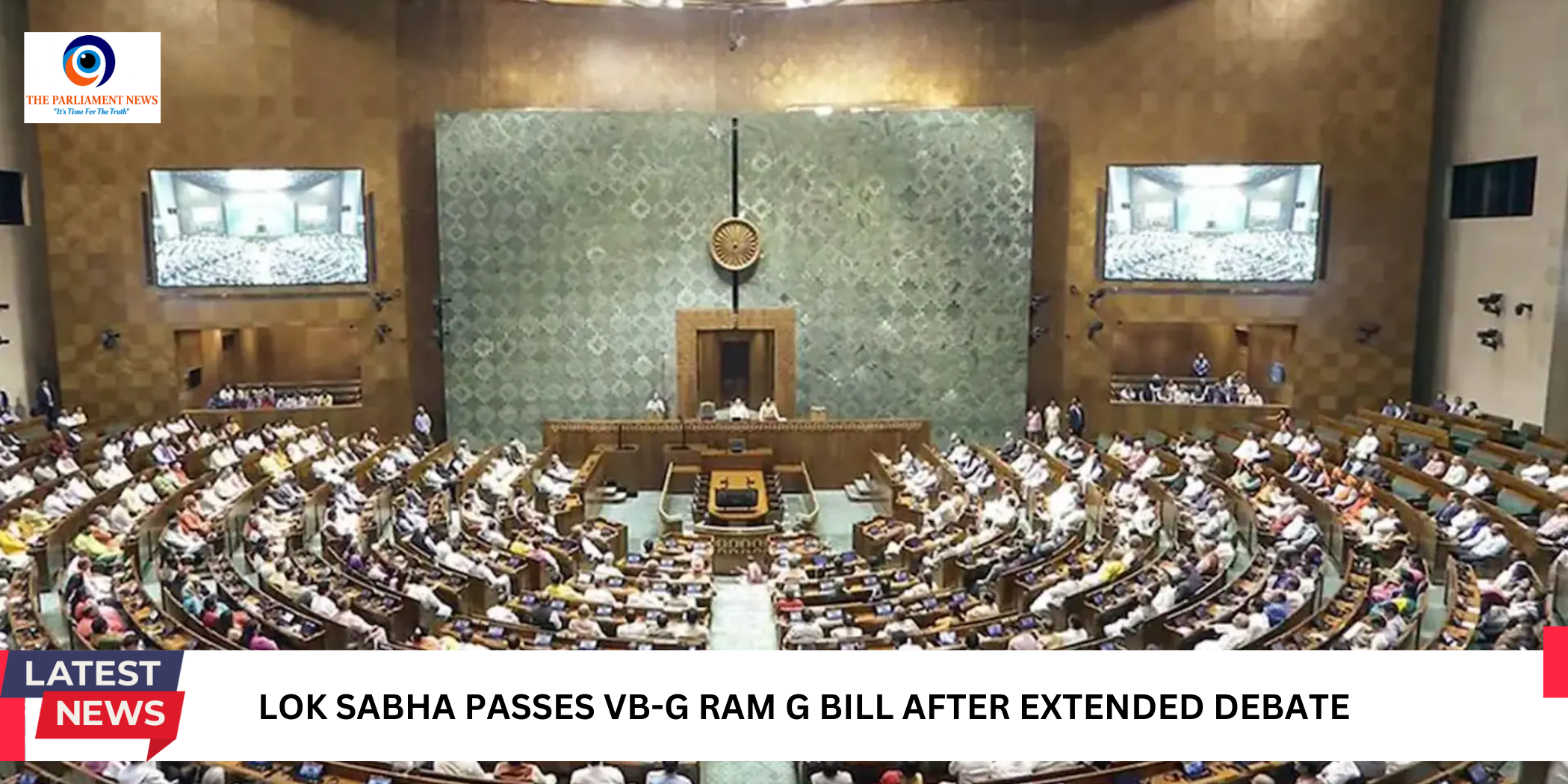
The Lok Sabha on December 18, 2025, passed the Viksit Bharat Guarantee for Rozgar and Ajeevika Mission (Gramin), known as the VB-G RAM G Bill, bringing a significant change to India’s rural employment framework. The legislation seeks to replace the Mahatma Gandhi National Rural Employment Guarantee Act (MGNREGA), which has been in place for nearly two decades, with a new programme guaranteeing 125 days of employment each year.
The Bill was passed through a voice vote amid protests by Opposition members, who raised slogans and expressed objections during the proceedings. Despite the disruptions, the government maintained that the legislation represents a necessary update to align rural employment policy with current development priorities.
Government’s Rationale for Replacing MGNREGA
Responding to a lengthy debate that stretched over eight hours, Rural Development Minister Shivraj Singh Chouhan defended the decision to replace MGNREGA. He argued that while the earlier scheme played an important role in providing income support, it had limitations that needed to be addressed.
According to the Minister, large public expenditures—estimated at ₹10–11 lakh crore over the years—had primarily gone toward wage payments. He stated that the new approach aims to balance employment generation with the creation of durable assets that contribute to long-term rural development. The emphasis, he said, should be on building “fully developed villages” rather than focusing only on short-term employment relief.
Focus Areas Under the New Programme
The VB-G RAM G Bill outlines a broader scope of work compared to its predecessor. The government has said the programme will prioritise projects related to water security, including the construction of lakes, water bodies, and micro-irrigation channels. These initiatives are intended to address chronic water shortages and improve agricultural resilience.
In addition, the scheme will support the development of core rural and livelihood infrastructure, such as access roads and facilities linked to local economic activity. Special provisions have also been included for works aimed at reducing the impact of extreme weather events, reflecting growing concerns around climate variability in rural areas.
All assets created under the programme will be digitally mapped and integrated into the proposed Viksit Bharat National Rural Infrastructure Stack. The government has described this as a way to improve transparency, planning, and coordination across rural development initiatives.
Opposition Objections and Demand for Scrutiny
At the start of the sitting, Congress MP K.C. Venugopal requested that the Bill be referred to a parliamentary committee for detailed examination. He argued that a policy shift of this scale required deeper scrutiny and wider consultation.
Speaker Om Birla declined the request, noting that 98 members from across party lines had already participated in the debate, which extended past midnight the previous day. He said the House had given sufficient time for discussion and that the legislative process had been followed.
As the debate progressed, Opposition members continued to protest, with some entering the well of the House and tearing copies of the Bill. The disruptions underscored the political sensitivity surrounding changes to a flagship rural employment programme.
Sharp Political Exchanges in the House
During his reply, Mr. Chouhan strongly criticised the Congress, accusing it of selectively invoking Mahatma Gandhi’s legacy while failing to uphold Gandhian values in practice. He said that refusing to engage with differing viewpoints also went against the principles associated with Gandhi.
The Minister argued that the current government’s welfare initiatives reflected those ideals more effectively. He cited schemes such as PM Awas Yojana, Ujjwala Yojana, Swachh Bharat Mission, and Ayushman Bharat as examples of policies aimed at improving dignity and quality of life for the poor.
He also pointed out that the rural employment scheme was initially launched as NREGA and that Mahatma Gandhi’s name was added later, ahead of the 2009 general elections. This, he suggested, was a political decision rather than a reflection of the programme’s core philosophy.
Linking the Bill to Long-Term Development Goals
Mr. Chouhan stated that the VB-G RAM G Bill should be viewed as part of a larger statutory framework aligned with the government’s vision of Viksit Bharat 2047. He maintained that the new programme is designed to modernise rural employment by integrating it with infrastructure development, climate adaptation, and digital governance.
The Minister also credited Prime Minister Narendra Modi with ensuring the effective implementation of MGNREGA during his tenure, countering Opposition claims that the new Bill undermines earlier welfare efforts. According to him, the proposed law builds on past experience while updating the structure to meet future needs.
What the Passage of the Bill Signals
The passage of the VB-G RAM G Bill marks a turning point in how rural employment is structured in India. Supporters see it as an attempt to move beyond wage support toward asset creation and village-level development. Critics, however, remain concerned about implementation, safeguards, and whether the new framework will provide the same level of employment security as MGNREGA.
With the Bill now cleared by the Lok Sabha, attention will shift to how the programme is rolled out on the ground and how effectively it balances employment generation with long-term rural infrastructure goals.
