


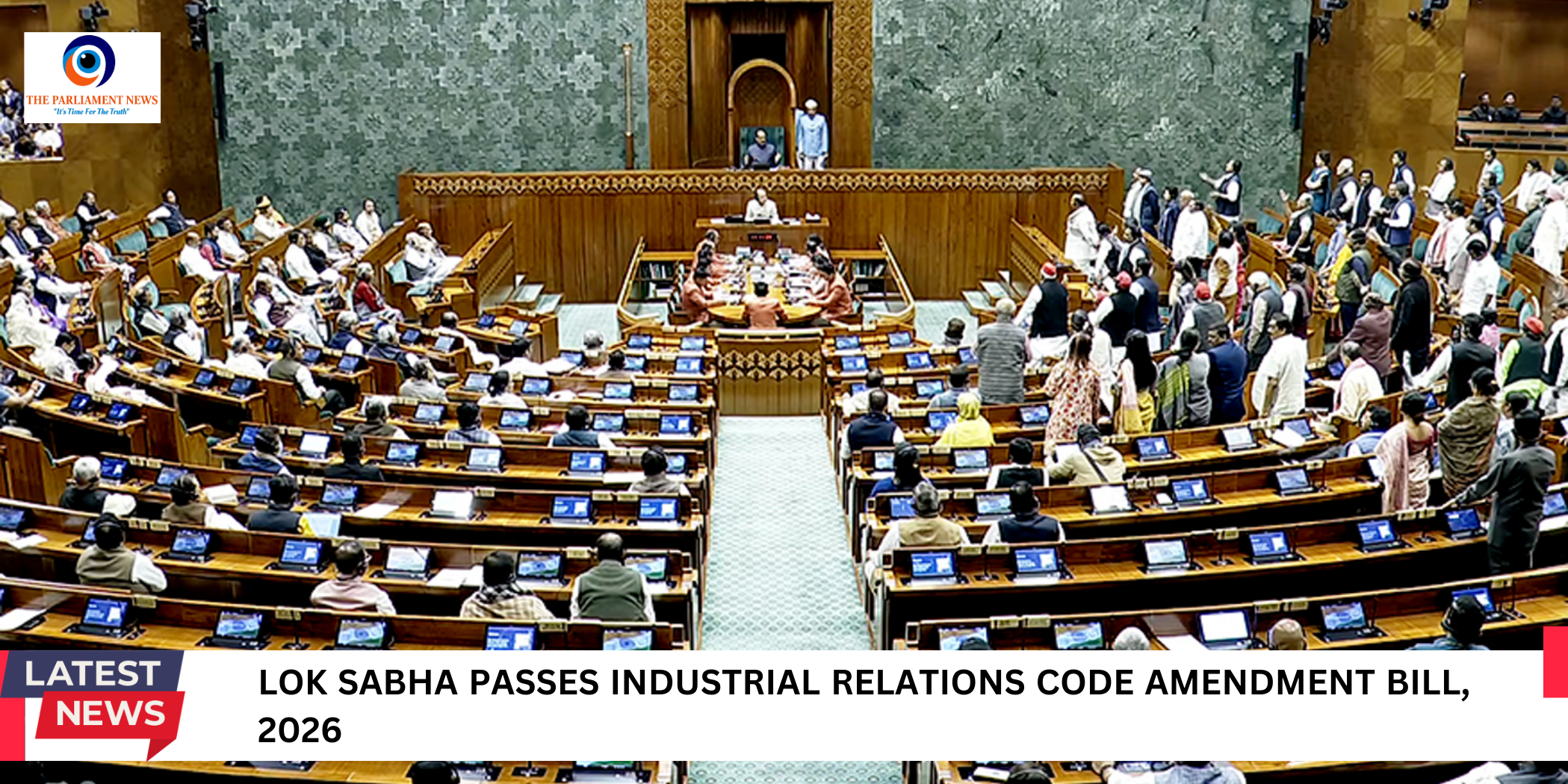
New Delhi, February 12, 2026: The Lok Sabha on Thursday passed the Industrial Relations Code (Amendment) Bill, 2026, aimed at ensuring legal clarity regarding the repeal of certain labour laws replaced by the Industrial Relations Code, 2020.
The amendment introduces savings provisions to avoid what the government described as any “future unwarranted complication” over the continuity of laws subsumed under the 2020 Code.
The Industrial Relations Code, 2020 consolidated and replaced three major labour legislations: the Trade Unions Act, 1926; the Industrial Employment (Standing Orders) Act, 1946; and the Industrial Disputes Act, 1947. These laws governed trade unions, industrial employment conditions, and industrial dispute resolution.
Clarifying the Repeal Provision
According to the statement of objects and reasons of the amendment Bill, Section 104 of the Industrial Relations Code already provides for the repeal of the earlier enactments. However, the government said there was a possibility of confusion arising from a “misconceived ground” that the Code delegated the power to repeal those laws to the executive.
The statement clarified that the repeal had occurred by operation of Section 104 itself, and that a notification issued in February 2026 reaffirmed this position. The amendment, it said, is intended to prevent any future legal uncertainty.
“It is considered desirable to introduce the proposed amendment to avoid any future unwarranted complication,” the statement said.
Savings provisions are typically included in legislation to preserve actions, rights, obligations, and proceedings initiated under repealed laws, thereby ensuring continuity and legal certainty.
Government’s Position
Replying to the discussion before the passage of the Bill, Labour Minister Mansukh Mandaviya said the four Labour Codes implemented nearly three months ago ensure key protections for workers.
He stated that the Codes guarantee minimum wages, mandate the issuance of appointment letters, and provide for uniform wages for the same work irrespective of gender.
The four Labour Codes covering wages, industrial relations, social security, and occupational safety were enacted to consolidate multiple central labour laws into a simplified framework. The government has maintained that the reform improves compliance and strengthens worker protections while promoting ease of doing business.
Opposition Criticism
During the debate, members of the Opposition criticised the government’s approach to labour reforms.
Congress MP K. Suresh said that instead of dialogue, the government “has chosen to dominate labourers.” He referred to a strike call given by workers on Thursday, describing it as a “warning signal” and reflecting what he termed policy shortcomings in addressing labour concerns.
Mr. Suresh also contrasted the current government’s approach with that of the previous United Progressive Alliance (UPA) government, citing the introduction of schemes such as the Mahatma Gandhi National Rural Employment Guarantee Act (MGNREGA) and the National Food Security Act as examples of pro-labour policies.
The debate highlighted differing political perspectives on labour reforms and their implementation. While the government emphasised legal clarity and structural reform, Opposition members raised concerns about consultation and worker safeguards.
With the Lok Sabha’s approval, the amendment Bill moves forward in the legislative process.
